
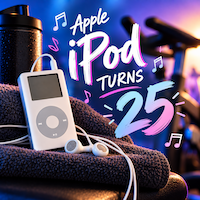
On October 23, 2001, the way we listened to music changed forever. Apple introduced the original iPod, putting up to 1,000 songs in our pockets and helping usher in a new era of portable digital music.
Twenty-five years later, we’re celebrating in our cycling classes with Hit Shuffle: The Sound of 2001 over Three Climbs, an Express Profile featuring the music that filled our playlists at the dawn of the iPod era. But before we get to the ride, let’s look back at why this little device was such a big deal, especially for indoor cycling instructors.
When Apple introduced the first iPod, the idea of carrying your music collection in your pocket felt revolutionary. The original model had a 5GB hard drive that could hold up to 1,000 songs, offered up to 10 hours of battery life, and weighed just 6.5 ounces.
“1,000 songs in your pocket” was Apple’s promise, and I had a particularly interesting perspective on just how significant that promise was.
In the late 1990s, I worked for Sony Electronics as a marketing manager in the portable audio category, which included the Walkman, Discman, and boomboxes. I had a front-row seat to an industry that was still largely built around physical media. When the iPod arrived in 2001, I understood just how significant the shift from analog and physical media to digital music could be. Sony had helped define portable listening with the Walkman, but the iPod fundamentally changed the category. Sony struggled to respond to that shift and never regained the same position it once held in portable audio.
I would later see another side of that transformation as an indoor cycling instructor. The ability to carry an entire music library on one tiny device had enormous implications for the way we could prepare and teach our classes.
A Paradigm Shift for Indoor Cycling Instructors
Think back to creating and teaching an indoor cycling class before portable digital music became commonplace.
Instructors relied heavily on physical media such as CDs and, earlier, cassette tapes. Creating a class meant selecting your music ahead of time, putting it in the order you wanted, and bringing it with you to the studio. Your choices in the cycling room were largely limited to what you had brought along.
The iPod helped change that.
Instead of carrying a stack of CDs, an instructor could carry an enormous personal music library on one small device. Playlists could be created and organized in iTunes and then synced to the iPod. Warm-ups, climbs, flats, intervals, recoveries, cool-downs, theme rides, and backup tracks could all travel with you.
It was a paradigm shift in the way instructors could think about music and class design.
Having so much music readily available made it easier to experiment with playlists and revise profiles. Instructors could organize music for different types of rides, collect songs that worked well at particular cadences, and maintain multiple playlists without carrying the physical music for every possible class.
And if you taught at multiple studios? Your music library could come with you.
The original iPod automatically synced songs and playlists from iTunes when connected to a Mac. Its FireWire connection was remarkably fast for the time; Apple said that 1,000 songs could be transferred in less than 10 minutes.
Today, we can open a streaming service, search for virtually any song, add it to a playlist, and have it available on our phones within seconds. It’s easy to forget what a dramatic change portable digital music represented.
The iPod helped bridge two very different eras of teaching: one in which instructors carried their music into the studio as physical media and the world we know today, where an enormous music library can be available from a device in our pocket.
From 1,000 Songs to an Entire Music Library
The original iPod was only the beginning.
Over the years, the iPod family expanded to include the iPod Mini, Nano, Shuffle, and Touch. Storage increased, devices became smaller and lighter, and the way we consumed digital music continued to evolve.
In 2022, Apple announced that the iPod Touch would remain available only while supplies lasted, bringing the iPod product line to a close after more than 20 years. Looking back on its legacy, Apple credited the iPod with redefining how music was discovered, listened to, and shared.
For indoor cycling instructors, its legacy can also be seen every time we build a playlist, organize songs around a profile, make a last-minute music change, or carry multiple classes with us on a single device.
We take that flexibility for granted today. Twenty-five years ago, it was extraordinary.
Hit Shuffle: The Sound of 2001 over Three Climbs
Now, let’s press play!
To celebrate the iPod’s 25th anniversary, this Express Profile takes riders back to the music of 2001 with three progressive climbs separated by recovery roads.
The playlist moves across genres in the same wonderfully unpredictable way our old music libraries did. You’ll hear Mary J. Blige, Linkin Park, P!nk, U2, Destiny’s Child, Faith Hill, Daft Punk, Creed, Train, Shakira, Lifehouse, Safri Duo, Smash Mouth, Dido, and Enrique Iglesias.
While you’re teaching, have a little fun with the anniversary. Ask your riders if they remember their first iPod. Which model did they own? What color was it? How many songs did it hold?
And, most importantly:
What was on your iPod?
Twenty-five years after Apple first put 1,000 songs in our pockets, we’re pressing play on 2001 once again.