
This article from the ICA archives was written in 2011. At the time, cadence computers were not yet commonplace on indoor bikes, and power meters in studio cycling were still years away from becoming accessible to most instructors. Many instructors simply had no objective way to understand how fast they were actually pedaling—or how cadence and resistance work together to create meaningful training adaptations.
Thankfully, cadence meters eventually became more common, helping many instructors realize just how fast they were riding. More recently, power meters have provided even greater insight into the relationship between cadence, resistance, and output. These tools have helped move the industry forward. But even today, there are still instructors who either ignore these principles, never learned them properly, or continue teaching excessive cadence with insufficient resistance.
To be clear, this article is not saying that pedaling above 100 rpm is inherently wrong. That’s never been the point. Higher cadences absolutely have their place. The issue is whether cadence is being used intentionally, appropriately, and in combination with enough resistance to create effective—and realistic—cycling training.
I also think it’s important for newer instructors to understand the evolution of indoor cycling over the past few decades and the frustrations many longtime educators have carried for years. Some of these conversations have been happening since the earliest days of the industry—and in some ways, they still are. Please read this article within the context of that time period, and be sure to read the follow-up article linked at the end.
A quick disclaimer before you dive in: this article was written during my very fired-up era at ICA. My passion for effective instruction and training came through with…a lot of intensity back then. 😄 I intentionally didn’t edit the original article when reposting it (except for a few grammatical errors and funky formatting), so you’re getting the authentic, dramatic 2011 version. It was also before I had an editor, which makes me especially grateful for Shari, who has been polishing my rough edges for many years now.
I was in California a few months ago (January, 2011) to take the first Real Ryder certification in Brentwood (Los Angeles) and to teach my Alpe d’Huez master ride at the Real Ryder studio. I had a chance to watch a lot of indoor cycling instructors-to-be on that Saturday. I had some long discussions with numerous California instructors about the other instructors they work with and the average indoor cycling instructor in California. I was, to put it bluntly, aghast at the speed at which these “instructors” were turning their legs as they rode.
As a result, I came to an important conclusion. I have thought this for many years, but haven’t verbalized it or written about it with the certitude I am about to give it. I now fully understand what I believe is the number one error being taught in the indoor cycling and Spinning® world. No, it’s not the pushups, squats, hovers, pedaling backwards, lifting weights while pedaling, isolations, etc., that are so prevalent at some facilities. As ineffective as those things are, they are not the #1 problem. And yes, there is a huge lack of knowledge about heart rate training and physiology in general amongst instructors. As unfortunate as that is, it’s not the #1 problem that must be fixed first.
The most pervasive problem is universal. It’s prevalent in California, I’ve seen it in Texas, and it’s all over the Northeast and the South. I’ve always been confounded at WSSC in Miami, Can Fit Pro in Toronto, ECA in New York, and more, because it was ever-present at every single conference where I’ve presented (that makes twenty conferences in 14 years). I’ve spoken with European, South American, and Asian Master Instructors who lament about it as well in their respective regions of the world. I see it on YouTube videos of indoor cycling classes and shake my head when I realize that this is what instructors are spreading to their students. It’s everywhere. Everywhere. All over the world.
And it might be you.
Someone has got to tell it like it is. Someone has got to have the nerve to call these instructors out. I guess I get to be the meanie….but it’s a role I’ll happily take on if it means potentially improving even just one instructor’s methods, and ultimately, in the process, helping one group of students.
What is the #1 thing that indoor cycling instructors do incorrectly?
Cadence. That is the #1 thing that indoor cycling instructors get wrong, yet it is so simple to resolve!
OK, I know that sometimes I’m preaching to the choir when I write on my blog or teach a session at a conference, because those people interacting with me want to learn how to be better. But for a moment, I’m going to assume that the person reading this is not one of the few people who comment on these posts. Because chances are, if you are commenting, you have bought into the “Keep it Real” philosophy of instructing and understand WHY a super fast cadence does not make sense. So if that is you, know that the following words are not for you, but for 99% of the other instructors out there……
I want you to imagine that I am talking to you: You pedal too fast. Your students pedal too fast.
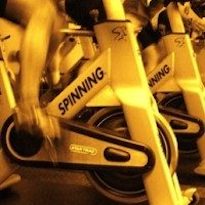
Ask yourself, what does 100 rpm look like? What does it feel like? What does 140 rpm look like? Feel like? The latter is everywhere—it was all around me that weekend in California, the weekend that caused this frustration to build in me. Legs blurring like the Roadrunner running from Wile E. Coyote, pedals whirring like hamsters on crack or like a weed-whacker trimming your lawn, all of this causing bobble butts in the saddle. I’m talking about the instructors! As a result, you have students from around the world trying to emulate their instructor because they have no idea that pedaling like this doesn’t make sense, and they feel like faster legs translates to more calories burned…
*Sigh*
It doesn’t.
Maybe you THINK that you aren’t pedaling that fast, but do you know for sure? Make it your goal to find out in the next few days when you get on your indoor bike. If you do not have a computer on your bike, then get a metronome. Or do cadence checks using the second hand of a clock. Better still, learn to pedal to the beat of a song that is 90 rpm, 95 rpm, 100 rpm. You, as an instructor, should know what 100 rpm (and above) feels and looks like, and you should know that 100 rpm should feel fast to you. Believe me, 100 rpm to a cyclist is a pretty fast cadence and is not easy to maintain for very long (for the mere mortals of the cycling world – we’re not talking pro here). If a cyclist found herself pedaling faster than that, she would most likely shift to a higher gear so the bike would go faster.
This is important: If 100 rpm feels like it is slow because you (and your students) are used to pedaling much faster, then yes, you need to adjust your thinking.
I repeat: 100 rpm is FAST enough for most situations on an indoor cycling bike. If it feels too easy or too slow, then you have not learned how to add resistance. That solution is plain and simple.
If you had a power meter, I could prove it to you objectively. But most of you don’t, so for the moment, believe me—if you’re turning those pedals over 110 rpm for longer than a few seconds and you aren’t an elite cyclist, you are much better off slowing down your legs and adding more resistance. You will get stronger, you will have more endurance, you will burn more calories, you will be more fit, you will meet your goals quicker—you and your students alike.
If you have doubts, email me. For much more detail on why excessive cadence with too little resistance is counterproductive, purchase my eBook Keep it Real to find out the physiological and biomechanical reasons behind pedaling at various rates.
But please, in the meantime, slow down your legs….
Please read the follow-up to this article here.
For reprinting of this article, please contact Jennifer Sage at Jennifer@indoorcyclingassociation.
this is not on the same subject, I saw an instructor teaching her class to jab to the right with the right hand and then to left, as if punching someone. What are your thoughts about this. Thank you